Ecliptic Mariner: Diaries DevLog #2 - Game Entry (And Other Foibles)
Last Updated: 2026-10-14 00:00:00 -0500
Ecliptic Mariner: Diaries is something a bit new for the lab - a video game, built in an engine. As most of you know, we’ve built a few game-like and toy like things here in the lab, but I’ve never actually set out to make a “video” game (we’ll see why I use those quotes in a moment), let alone one built on someone else’s engine. Since the last update, progress has been plugging along (at something resembling a pace), so it seems like a good time to share progress again.
Godot Kind of Hurts My Head
Fo, over the last couple of months, progress has been a little slow for two real reasons. The first, as is often the case with development projects that become projects, is that I was only working on it on stream, and September being September, I didn’t stream much. The second, and much more relevant reason to the rest of the work on the project, is that Godot more or less works exactly backward to how my brain would like to work.
The game engine really is designed around building the scene/frontend objects first, and only coming in to work out the functionality as a kind of glue logic behind those objects. It’s not an impossible paradigm to think in, it’s just the reverse of how I would normally approach a problem. In a way, it’s actually kind of reminiscient to working on python-enigma, which also worked by kind of building the objects that were the “parts of the machine” and then figuring out how to make those parts interoperate.
Emulating Terminal Output
One of the first major challenges - a result that’s kind of hard to demonstrate in a still image; was making an object in Godot function a bit like a terminal. Now, I don’t mean truly implementing a terminal or accepting and interpreting input; there are plugins for that. What I wanted - all I wanted, in this case - was something I could basically dump text to.
I found it in modifying a RichTextLabel, and after only a few hours of wrapping my head around it, the most primitive possible proof of concept for the game’s main menu was born:
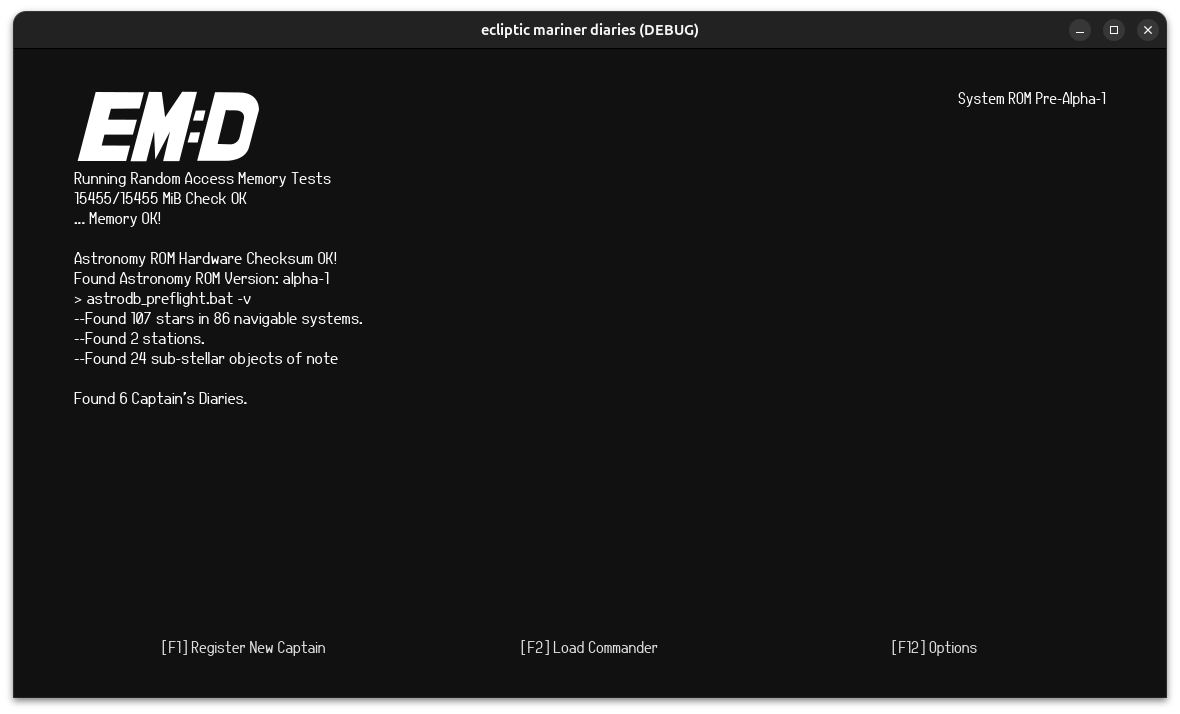
Now, if that looks boring to you, it wouldn’t be your fault. What a still image really isn’t illustrating well is that all those text lines are animated. With some cheaty delay logic and funny maths, the memory check really does count up across your RAM. The Astronomy ROM DB really is interrogated by the animation.
I still want to go back and do further visual improvements across this whole screen - including changing the animation a bit, and these strings are all hardcoded, so I also need to learn how the engine natively wants to do localization for future reference, and backport that functionality in.
A ‘New Game’ Scene Designed For Evolution
The next logical thing to build was the New Game screen, which in a way I built twice. The first version was more or less identical to this screenshot, which is from the second (current/future) version:
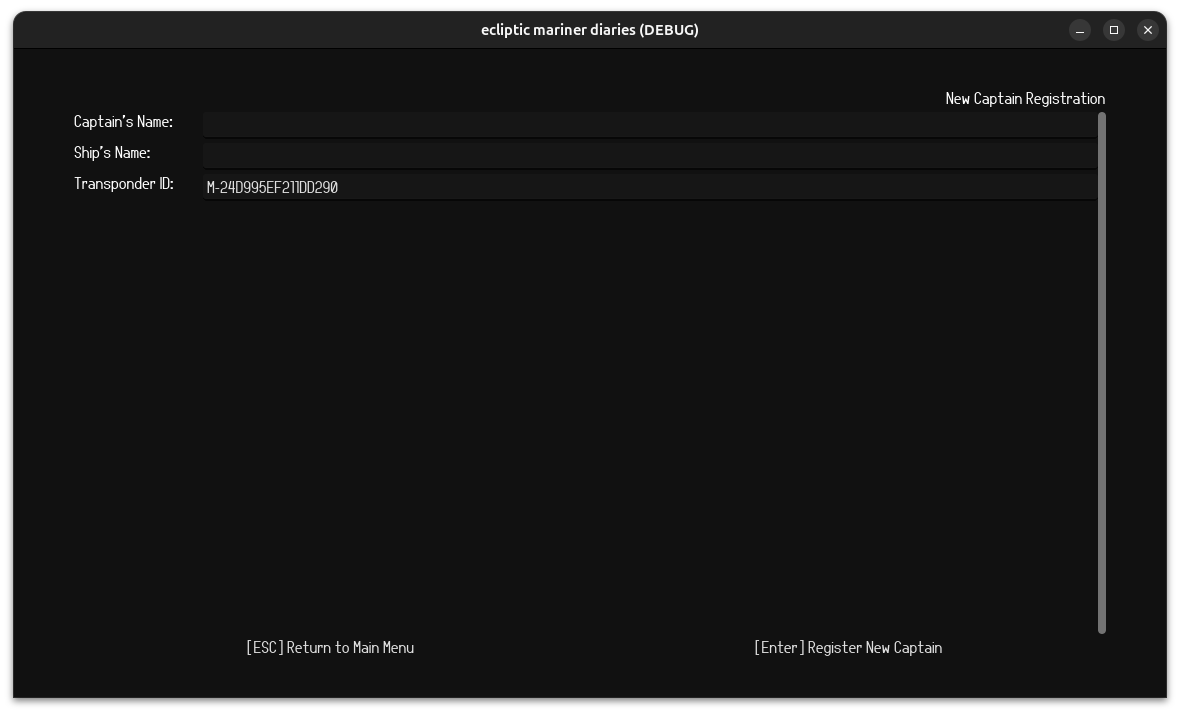
The rebuild’s cause? In the first version, I hand-placed the labels and fields the scrollbox, and the script that sits on the “Submit New Game” would have to be modified (along with the scene itself) every time I wanted to add a new field to the New Game Screen (which, as time goes on, will likely be quite a few things.)
This didn’t really suit my mentality at all, so I rebuilt the scene a couple days later to now accept a software definition of the form fields, which looks like this:
## To begin with, let's establish the fields in the simplest terms
var array_newgame_options = [
    {   # Captain's Name
        'label': "Captain's Name",
        'type': "TextEntry",
        'init': "",
        'machine_label': "NameCaptain",
        'db_table': "config",
        'db_key': 'name_captain'
    },
    {    #Ship's Name
        'label': "Ship's Name",
        'type': "TextEntry",
        'init': "",
        'machine_label': "NameShip",
        'db_table': "config",
        'db_key': 'name_ship'
    },
    {    #Transponder ID
        'label': "Transponder ID",
        'type': "TextEntry",
        'init': generate_transponder_id(),
        'machine_label': "TransponderId",
        'db_table': "metadata",
        'db_key': 'transponderId'
    }
]
Simples, right? I can expand this in the future if I want to add tooltips, and if I want to add new entry types I can so long as I update a few match statements in places to support it. Simples Simples.
This means that the game can now create a save file from the astronomy rom and the player’s inputs. Later, this’ll be where things like world generation procedures and the initial economy simulation run get triggered.
Save File Forward Compatibility (Yes, This Early)
Something I’m considering right from the outset is something I’m calling “save file forward compatibility”. I want it to be possible to build logic that can incrementally upgrade a save file to include any missing data from a previous version to the current game version. If it seems early for that, it is: I distinctly remember many of the Early Access games I’ve played over the years having this problem, and those games were all much further along their development curve than this one is.
But here’s the thing: EM:D is a productivity game. It’s going to have time and task tracking features. And I would like to be able to use those and keep using them from version to version, because it’d be fun to use that as a way to track the game’s development.
So part of making the newgame fields software-defined was doing the same thing for a save file definition, and part of the load game logic moving forward is going to have to be schema validation and techniques for resolving schema conflicts. Fortunately, the save file is a SQLite file, so this is just a Database Administration task.
And I’m qualified to solve those problems.
Building the Load Game Menu
If you can save a game, it stands to reason you should be able to load it:
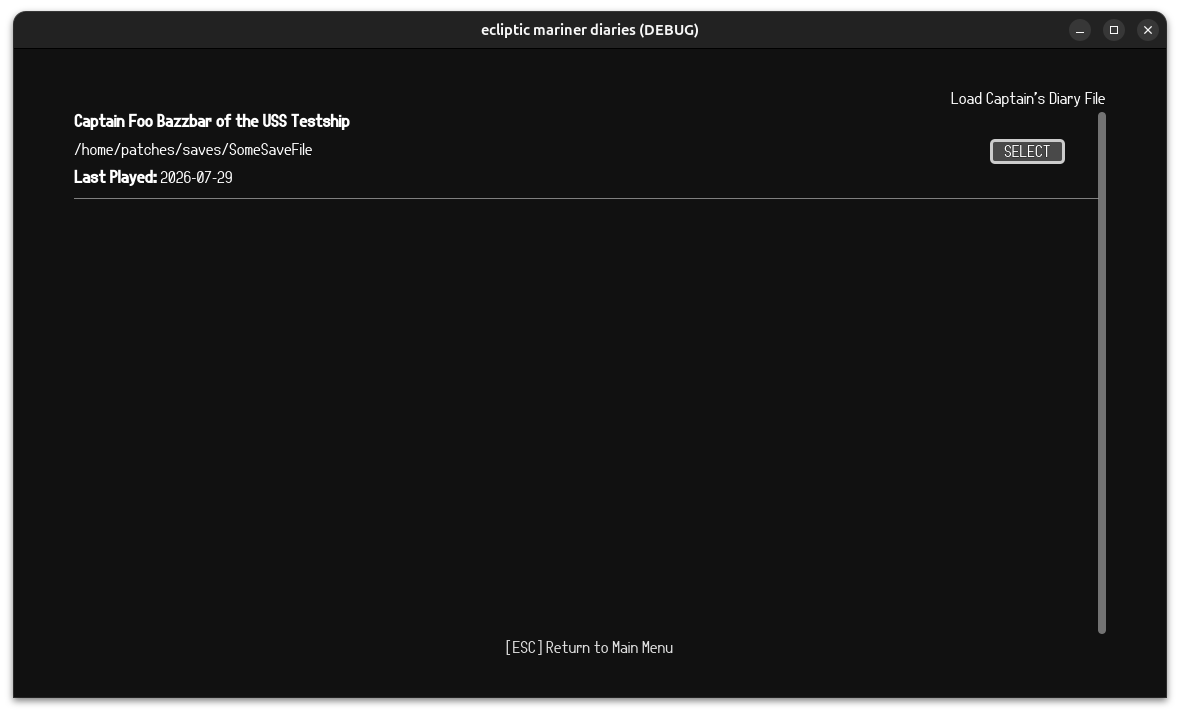
This is actually nothing more than a look-and-feel prototype if you’re reading this post right when it’s posted. Like with the new game screen, the scene needs to be rebuilt in a way that supports drawing those boxes and buttons for every file in the saves directory. Conceptually very simple. Implementation wise, we’ll see this afternoon.
Starting around or shortly after 7 PM ADT on Wednesday, October 14, I’m going to be live in the usual place for the balance of the evening working on EM:D (it is, after all, Wednesday), and finishing the loading screen, along with figuring out how to pass a game state object from either load or new game into the main game scene, is going to be the focus.
Aren’t These Features Premature?
In most gamedev tutorials, save game functionality doesn’t seem to be a priority. In part because “baby’s first game” is usually a bit simpler than this, and has an arcade-style “just go for the high score” gameplay loop, and in part because the way you’re going to save a game is highly bespoke, depending heavily on the type of game you’re building and how you’ve built it.
However, if I’m being honest, I’m envisioning most of the gameplay state management as, basically, database operations triggered against a godot node in the main game scene that just handles the DB connection and has all the logic for each kind of state change canned. The database that thing is acting against is the save file, so in order to develop any part of the game, I needed the save file first.
From here though, we’re free to implement anything in almost any order we want. Obviously we need to implement the “core” UI scene first, but once that exists, we can implement the game features in more or less any order. I think I’m going to start with the tasks system, then the timers system, and only once their basic versions exist, will I go in and add the “space stuff”. Then probably loop back around to the ideas that make the game truly unique, like the contracts engine. A full roadmap of major features is forthcoming.
Lastly, A Question for the Reader
Yesterday I was working on an unrelated space travel problem for an Ecliptic Mariner short story that’s on my kanban board and I came to a realization: other than moon-planet or moon-moon transfers in the same planetary system, flights in the EM:D universe are kind of long. So my question to you is this:
Given the choice between having the ability to fast forward time or having an in-game time that’s tightly coupled to the system time, what would you prefer in an idler game that’s kind of a planner?
and, perhaps as importantly:
Would you play a space game in which some flight plans would take multiple days to conclude, if the game provided you sufficiently interesting things to do while you were in flight, and what is your interpretation of “sufficiently interesting”?
I’m not saying the feedback will be the only consideration as we get there - and if I’m being honest, we’re at least several months away from “getting there”, but this was a big mental hiccup in the game planning once the thought was clear to me.
Ecliptic Mariner: Diaries is just one of the many projects produced and maintained at the Lab. At the time of writing especially, ongoing development of any of these projects is funded almost solely by the contributions of our generous supporters. Regardless of where the die finally lands on licensing with Ecliptic Mariner: Diaries, your support at this time is crucial in helping us to make the game become a reality.